
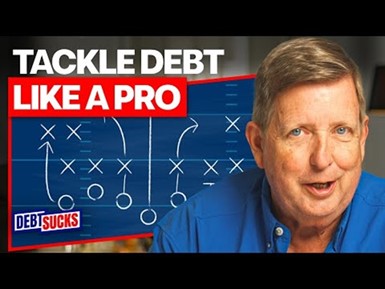
Is your budget in the injury tent?
Football is a game of strategy, fundamentals, and execution—and so is managing your debt. Here are some tips for planning and executing the perfect plays to get your debt under control. For more information, check out attorney Ben Matthews’ podcast, Debt Sucks.
The kickoff: starting the game
Just like in football, you can’t win without knowing your field position. Here’s how you start getting your money under control: write down all your debts. That includes credit cards, medical debt, student loans, car loans, personal loans, and so on. Even the little stuff matters; it’s yardage you’re losing before you even run a play.
Your offensive strategy
On offense, what counts is moving the chains, whether you do it with a big pass or a short run. In money terms, you make forward progress by keeping up with your payments:
- The short run: that’s your minimum payments. They don’t win the game, but they keep you from getting pushed back by late fees and collections.
- The first down is when you free up some extra cash to put toward paying off your smallest debt. That might mean cutting back on nonessential purchases like subscriptions or picking up a little extra income.
- The big play: line up all your debts and hammer one of them straight into the ground. This is a full-on piledriver, not a polite tap.
Say you have three credit cards with balances of $1,000, $3,000, and $5,000, respectively. You make your minimum payments—short runs—on each one to keep the late fees off your back. You get some first downs by freeing up some additional cash for debt repayment. Then you pile every last dollar you can spare onto the $1,000 debt—that’s the piledriver! —and when it’s paid off, celebrate your touchdown.
Then, you roll those payments into the next debt and repeat the process.
Your defense
As any coach will tell you, defense wins championships. You can have the best offense in the world, but if you let the other team run all over you, you’re still going to lose.
In money terms, the “other team” is life itself—and it won’t pull any punches. An unexpected car repair or medical expense can blindside you, and if you don’t have a defense, those costs will go right on your credit card.
So, what’s your all-important defensive line? It’s your emergency savings. Even a starter fund of $500 can buy you time, stopping you from pulling out the credit card in panic mode. That gives you a fighting chance to stay in control and keep making progress.
Halftime adjustments
What plays aren’t working? What do we need to change up to win the second half? Good coaches use halftime to reset and make adjustments. You need to do the same.
Your halftime assessment involves regularly reviewing your spending habits and making adjustments. Look at your subscriptions, Amazon history, DoorDash account... every place where money is leaking out of your budget. Making cuts is hard, but you have to do it to stay in control.
Winning the fourth quarter—and overtime
When the endzone is in sight, you can’t let your guard down just yet. You’re on the verge of being debt-free, but FOMO—fear of missing out—may tempt you to start spending recklessly again. That’s the equivalent of spiking the ball on the five-yard line. Don’t give up until you cross the goal line, debt-free.
Then there’s overtime: the unexpected car repair or other major expense that puts you right back in debt, or the bill you forgot about. That’s no fun, but keep running your winning playbook and finish the game. Then, you get to play for the championship: saving for retirement, building wealth, and securing your legacy.
Follow your game plan, and know when you need a lifeline
Here’s your game plan for this week: take stock of your debts (field position), keep up with your payments (short runs), free up some cash (first downs), and knock out one bad spending habit (halftime adjustment). Like most great playbooks, it’s not flashy, but it keeps you making forward progress, and that’s what you need to win the big game.
That said, if you’re drowning in debt, you don’t need a game plan; you need a lifeline. When you’re beat up, out of timeouts, and the other team is running up the score, bankruptcy takes you straight to the start of a new season.
Give us a call or contact us online to speak with a bankruptcy attorney at Benjamin R. Matthews & Associates, LLC.
“Once they started my case, it was less than a week before my creditors stopped with the harassing calls and emails. Everything after that went fairly smooth. I’m very satisfied with the experience.” – Martin R., ⭐⭐⭐⭐⭐